
I have always used acupuncture as part of my health and system therapy. It is an ancient art that I actually feel working as chi energy is realigned, released and opens blocked areas or my body. Literally I feel a sense of “flow” thru my body when the needle is inserted into the meridian channel. Within 5 minutes, I zone out. Completely and fully asleep, and 30 minutes later, I leave my doctor completely relaxed and reset physically and mentally.
I have been doing it for more than 20 years. Using the system seasonally as a tune-up, per se.
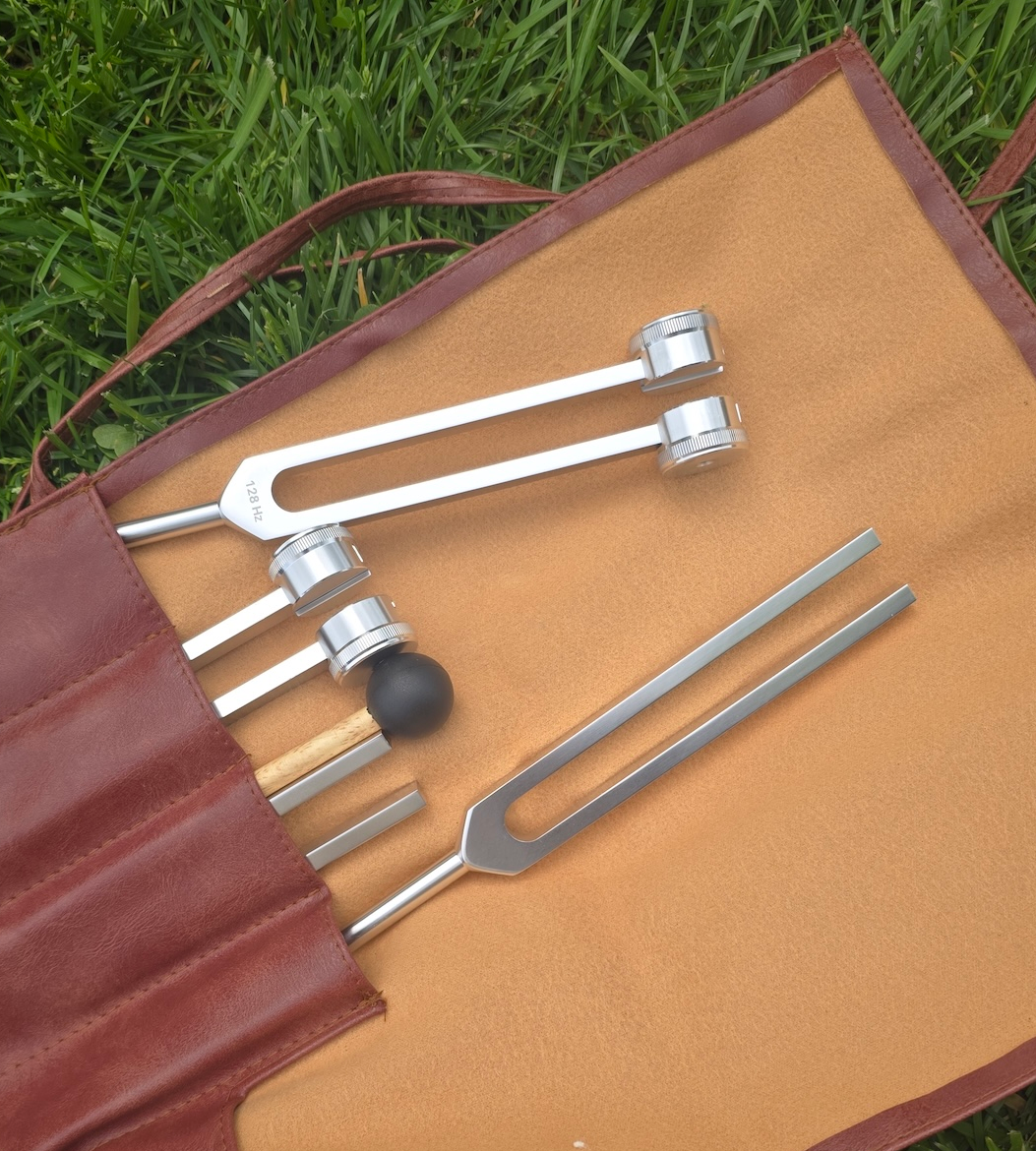
Well, I recently found a beautiful set of tuning forks and began using them as a morning “sound vibrational realignment” ritual. I do it before or after coffee and definitely before my first client session. Felt like I was giving myself an “acupuncture-sound-vibration” treatment each morning. Using simple sequences suggested by the provider that resonated with me, essentially targeting triggers points along the spinal/chakra/meridian path with the vibrational tool.
And of course, being a movement teacher, adding the balance disc was an absolute necessity. Keep reading about the traditions below and then pay attention to the balance board (I am standing on pictured below) “silent itself out” during the sequencing. I think it reflects just how effective, powerful and integrative the vibrational tool really is with my movement practice.
Vibrational Sound Therapy
Vibrational sound therapy (VST) can retune your body, mind and spirit, encouraging relaxation, healing and wellness.
The origins of VST trace back to ancient healing traditions while incorporating modern scientifically and evidence-based protocols. Sound has been utilized in healing practices for millennia across various cultures, such as in ancient Egypt where priests employed vocal toning and instruments like harps, flutes, and sistrum to restore health and induce altered states; in ancient Greece where philosophers like Pythagoras and physicians used flutes, lyres, and zitters to aid digestion, treat mental disturbances, and induce sleep; in ancient India where mantras, chanting, and music therapy were staples in temples for balancing energies and removing ailments; in Aboriginal Australian traditions employing the didgeridoo for respiratory healing and spiritual alignment; or in indigenous shamanic traditions worldwide using drums, rattles, and chants to induce altered states for physical and spiritual healing.
Ancient cultures believed that sound vibrations could harmonize the body’s energy fields, aligning chakras and restoring equilibrium.This one-on-one service uses therapeutic “singing bowls” placed on the body to create a combination of tones and vibrations that produce a state of tranquility and act as a massage for the nervous system.

VST operates on the principle that everything in the universe, including the human body, is in a state of vibration. The body is composed of approximately 60-70% water, and sound waves travel more efficiently through liquids and solids than air, allowing vibrations to penetrate deeply at a cellular level. When a therapeutic singing bowl is struck, it produces harmonic overtones and low-frequency vibrations that resonate with the body’s natural frequencies. This resonance helps “retune” imbalanced areas, much like tuning a musical instrument.
VST alleviates stress by lowering cortisol, leading to 62% average decreases, and eases anxiety through parasympathetic activation, with 59% improvements reported. Enhanced sleep, mental clarity, and emotional release are common, as vibrations help dissolve “blocks” like trauma or built-up tension. Clients of the system often describe feeling “lighter” or “floating,” with long-term effects including better mood, reduced inflammation, and boosted immunity.
When relaxing through soothing sound and vibration, your body is affected on a cellular level, opening energy flow to move you back toward healthy alignment. Stress creates an unhealthy flow of energy, first appearing as low energy in your aura, and, later, as ill health, mentally and physically.
Exactly as acupuncture does.


Tuning Forks
Tuning forks create precise frequencies that can be applied directly to the body or held near the ears. That’s why they feel more “scientific,” each fork vibrates at an exact pitch (like 136.1 Hz for the heart chakra).
Tuning Forks: Precision Healing Tools
Tuning forks may look simple, but they’re some of the most precise sound healing instruments you can use.
Unlike bowls, which produce layered tones, forks vibrate at a single, exact frequency. That makes them powerful tools when you want direct results.
Whether used inside, on the balance board, or outside “grounded” into the earth, I plan to keep the tuning forks as part of my movement therapy arsenal.
When struck, a tuning fork generates vibation that can be applied in two ways:
- Directly to the body with weighted forks, placing the stem on bones, muscles, or acupressure points to send vibration deep into tissues and energy channels.
- Around the body’s energy field with unweighted forks, holding them near the ears, chakras, or aura to influence energetic balance.
Common frequencies include those for:
- Digestion & gut balance (low Hz forks to calm the stomach)
- Pain & inflammation relief (forks supporting circulation and tension release)
- Better sleep & relaxation (forks that entrain brainwaves to slower states)
- Emotional balance (Solfeggio frequencies or chakra forks to clear stuck energy)
Sounds woo-woo AF!
I know!
Yet, the benefits of vibrational sound therapy are numerous. Vibrational sound therapy can:
- Lower blood pressure
- Reduce stress
- Reduce pain
- Ease blockages and tension
- Reduce depression
- Improve sleep
- Boost creativity
- Improve concentration
- Balance energy fields (aura) and chakras
Check out what the movement and balance stretches …. after the tuning alignment is complete …. here.
Felt like I was giving myself an “acupuncture-sound-vibrational” realignment
In fact, that was true, for “traditional Eastern medicine approaches perceive the individual in more wholistic terms, and thus, treatments are directed toward the whole self-system rather than merely a dysfunctional aspect of our physiology.
Many of these approaches draw from ancient Eastern philosophies. The way in which the concepts have recently been applied may be characterized as novel and forward-thinking, including applying vibrational medicine to arenas such as regenerative medicine and psychosocial stress.
There are numerous traditional medicine techniques from the East including yoga, Tibetan sound healing, acupuncture, Tai Chi Chuan, and Qigong among others that are recognized around the globe for their potential relaxing and healing properties.”
Acupuncture is a complex technique based on Chinese Medicine philosophy regarding the body’s meridians, and could be characterized as linked to the principles of Yin and Yang.
Yang is represented by the needlepoints with their sharp, metallic, focused points, while Yin is represented by the human body, which is softer, more complex, and organic.
The human body’s meridians (a system of bodily energy flow, or qi flow) are regarded as the underlying mechanism of acupuncture. Twelve major meridians exist in the body and are associated with the primary organs: heart, lung, pericardium, spleen, liver, bladder, kidney, stomach, gallbladder, small intestine, large intestine, and ‘Triple Warmer.’

Leave a Reply